Anterior Pelvic Tilt: What the Evidence Actually Says
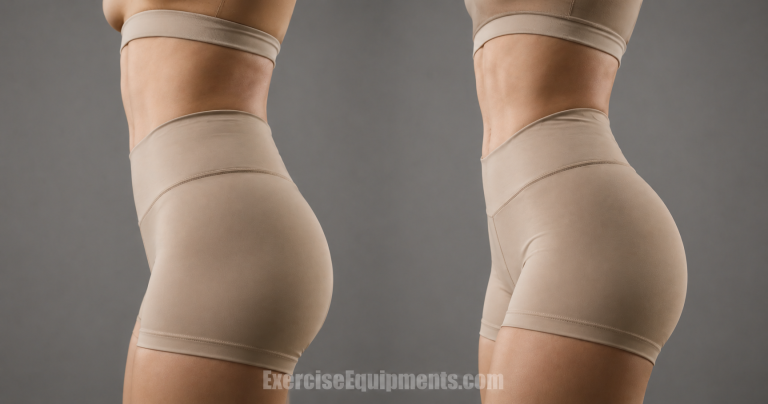
When you stand, your pelvis naturally sits at a slight forward angle. For many people, however, that forward tilt is more pronounced. This is anterior pelvic tilt (APT): a postural pattern where the front of the pelvis rotates downward and the back lifts upward.
It’s remarkably common. One study of 120 people in their early to mid-20s found that 85% of males and 75% of females had some degree of anterior pelvic tilt. Only a small minority — 9% of males and 18% of females — had what could be considered a neutral pelvic position.
But here’s the crucial detail: that study examined a normal asymptomatic population — 120 healthy young people with no pain or symptoms. The majority of pain-free young adults walk around with some degree of anterior pelvic tilt.
So the real question is: Is anterior pelvic tilt actually a problem? And if so, what actually fixes it?
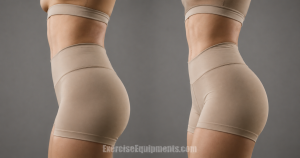
What Anterior Pelvic Tilt Actually Is
Anterior pelvic tilt is defined as excessive forward rotation of the pelvis, which typically results in increased lumbar lordosis — a more pronounced curve in the lower back.
Think of the pelvis as a bowl. In neutral, it sits level. In anterior tilt, the front of the bowl tips downward and the back tips upward. This pulls the lumbar spine into greater extension.
Measurements vary widely depending on the method used, and there is no single universally accepted “normal” value. Different studies use different landmarks and protocols, making direct comparisons difficult.
Why It Happens: The Muscle Imbalance Model
The most widely accepted explanation for APT is a muscle imbalance — a “tug-of-war” between opposing muscle groups.
The Tight Side (Overactive)
- Hip flexors (iliacus, iliopsoas, rectus femoris) pull the front of the pelvis downward
- Lumbar extensors (lower back muscles) pull the back of the pelvis upward
The Weak Side (Underactive)
- Glutes lack the strength to counteract the anterior pull
- Abdominals fail to provide the core stability needed to maintain neutral alignment
The commonly cited driver is prolonged sitting. When you sit for hours, your hip flexors remain in a shortened position, adaptively shortening over time, while your glutes and core remain relatively inactive. This is the standard clinical explanation, based on biomechanical logic and adaptive shortening principles. However, the specific evidence directly linking prolonged sitting to the development of APT is largely inference rather than direct longitudinal data. The model remains the standard clinical framework — but it should be understood as a plausible mechanism, not a proven etiology.
A note on this model: The hip-flexor/glute imbalance explanation is widely taught in physical therapy and strength training. However, it is largely based on clinical reasoning and biomechanical logic rather than a single definitive study. The evidence supporting it is circumstantial — consistent, but not causal. The model is plausible, widely used, and clinically useful, but it should be understood as the best available framework, not settled fact.
The Potential Consequences (What the Evidence Supports)
The consequences commonly attributed to APT deserve careful scrutiny.
Lower back pain: This is the most frequently cited consequence of APT. The reasoning is biomechanically plausible — increased lumbar lordosis should, in theory, place additional stress on spinal structures. However, the meta-analytic evidence does not support this. A 2014 systematic review and meta-analysis of 43 studies found that lumbar lordosis angle did not differ between people with and without low back pain (8 studies), and standing pelvic tilt angle also did not differ between groups (3 studies). If APT were a primary driver of low back pain, these differences should exist — and they do not.
Hamstring strain and injury risk: This is better supported. A 2024 cadaver study using seven fresh-frozen specimens found that increased anterior pelvic tilt produces significant, non-uniform elongation of all three hamstring muscles. The authors concluded that “the pelvis segment will likely play a fundamental role as a strain regulator of hamstring muscles”. This suggests APT may be a meaningful risk factor for hamstring injuries in sports involving high-speed running, though cadaver studies have known limitations.
Limited hip extension: With excessive anterior tilt, the hip joint’s position changes, which may limit hip extension and alter gait mechanics. This follows from the geometry of the joint.
Reduced athletic performance: This is commonly claimed but not well-established. The evidence is largely inferential.
Gluteal inhibition: Underactive glutes become a self-reinforcing problem — this is part of the muscle imbalance model and follows logically from the model’s assumptions.
The bottom line on consequences: The standard narrative — APT causes low back pain — does not survive meta-analytic scrutiny. The strongest evidence for APT as a problem is in hamstring mechanics and hip arthroscopy recovery, not in back pain.
What the Research Actually Shows
The Evidence for APT as a Problem
Hamstring strain: The 2024 Mendiguchia et al. cadaver study provides direct biomechanical evidence that APT increases hamstring elongation. This is the strongest mechanistic evidence linking APT to injury risk.
Return to sport after surgery: A 2025 study of 92 active-duty U.S. Army personnel found that increased anterior pelvic tilt (≥7°) was correlated with lower odds of return to duty and return to running after hip arthroscopy for femoroacetabular impingement (FAI). This is a specific post-surgical population, which limits its generalizability to asymptomatic individuals, but it suggests APT matters in rehabilitation contexts.
Shoulder range of motion: A 2025 study by Lobbos et al. found that when healthy adults actively tilted their pelvis forward on command while standing, shoulder flexion increased and shoulder extension decreased (p < 0.001). This demonstrates acute mechanical coupling between pelvic position and upper-body movement, but it’s an evoked, voluntary position change — not evidence about people who habitually carry APT. It shows what happens in the moment, not what chronic APT does to shoulder function.
Prevalence: Herrington (2011) found that 85% of asymptomatic males and 75% of asymptomatic females had anterior pelvic tilt. This suggests APT is the default pelvic position for most young adults, not an outlier.
The Counter-Evidence: Does Fixing APT Actually Matter?
This is the question the fitness industry rarely asks — and the evidence is uncomfortable.
Laird, Kent, and Keating (2012) systematically reviewed 12 trials examining whether modifying movement patterns in people with low back pain actually helps. The authors directly address the central question of this article, stating: “Despite a common assumption that posture is related to low back pain, studies of interventions that measure changes to posture are scarce, and a relationship between postural modification and improvements to pain or activity limitation has not been established.”
However, the underlying data is more nuanced than the abstract suggests. Of the 12 trials, only three examined lumbo-pelvic kinematics or postural patterns, and only one focused primarily on posture. Two of those three trials (Haugstad; Magnusson) did report improvements favouring the intervention. But the quality of the evidence is poor — the mean PEDro score across the 12 trials was 5.6/10 (range 3–8), and Magnusson’s positive postural trial scored just 3/10, with the authors noting its effect sizes were “unusually large” and that replication is warranted. Haugstad studied women with chronic pelvic pain, not low back pain.
The takeaway remains consistent with the article’s argument: across all 12 trials, movement-based interventions were infrequently effective, and no relationship between postural modification and pain improvement has been established.
The kinematics evidence is even more direct. A separate meta-analysis (Laird et al., 2014) pooled 43 studies comparing lumbo-pelvic kinematics in people with and without low back pain. The findings relevant to this article:
- Standing pelvic tilt angle did not differ between people with and without low back pain (3 studies pooled).
- Lumbar lordosis angle also did not differ between groups (8 studies pooled).
- People with back pain did move differently — more slowly, with reduced lumbar range of motion and reduced proprioception — but static pelvic tilt alone was not a distinguishing feature.
This is the closest thing to a direct answer in this article. If standing pelvic tilt does not distinguish people with pain from those without, the assumption that APT is a primary driver of low back pain is not supported by the evidence.
The evidence gap: We don’t have a large, high-quality randomized controlled trial demonstrating that correcting APT improves long-term outcomes like pain reduction, injury prevention, or athletic performance in the general population.
What we don’t know: Whether the muscle imbalance model — tight hip flexors, weak glutes — is actually causal or merely correlated with APT. The model makes sense biomechanically, but correlation is not causation.
Exercises Commonly Prescribed to Change Pelvic Position
The standard approach to APT is two-pronged: stretch the tight muscles, strengthen the weak ones. This approach is grounded in biomechanical logic and clinical experience, though its long-term efficacy for treating back pain lacks robust RCT evidence — and the meta-analytic evidence shows no link between APT and back pain.
Stretch (Lengthen the Overactive Muscles)
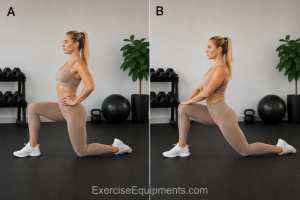
Half-kneeling hip flexor stretch: Kneel on one knee with the other foot planted in front at a 90-degree angle. Drive your pelvis forward gently. Hold for 30 seconds per side.
Quadratus lumborum / side stretch: Kneel and reach forward, stretching through the side body.
Strengthen (Activate the Underactive Muscles)
Glute bridges: Lie on your back with knees bent and feet flat. Press through your heels to raise your hips until your body forms a straight line from shoulders to knees. Perform 8–12 repetitions.
A note on the evidence: A 2015 EMG study (Choi et al.) found that during a glute bridge, adding band-resisted isometric hip abduction immediately increased gluteus maximus activity and reduced the anterior pelvic tilt angle while performing that specific bridge. This is a single-session, acute measurement of exercise mechanics — not a long-term training study demonstrating persistent postural change. It suggests the exercise activates the right muscles, but it does not prove that doing this exercise will permanently correct your resting posture or improve back pain.
Dead bugs: Lie on your back with arms extended toward the ceiling and knees bent at 90 degrees. Slowly extend one arm and the opposite leg while maintaining a neutral spine.
Planks and core stability work: Strengthening the abdominals helps support a neutral pelvic position.
Pelvic tilts: Lie on your back with knees bent. Practice tilting your pelvis posteriorly (flattening the lower back against the floor) and anteriorly (arching the lower back). This re-educates pelvic positioning.
What to Avoid
Do not simply “tuck your tailbone” or force a posterior pelvic tilt throughout the day. This creates a different imbalance and can flatten the natural lumbar curve. The goal is neutral, not posterior.
Summary Table
| What We Know | What We Don’t Know |
|---|---|
| APT is extremely common (85% of asymptomatic males, 75% of asymptomatic females in one study) | Whether the muscle imbalance model is causal or correlational |
| APT increases hamstring elongation in cadaver models (7 specimens) | Whether correcting APT reduces long-term back pain in general populations (the meta-analytic evidence shows no difference in pelvic tilt between pain and no-pain groups) |
| Standing pelvic tilt and lumbar lordosis do not differ between people with and without back pain (3 and 8 studies, respectively) | Whether acute shoulder ROM changes with voluntary pelvic tilt translate to chronic APT effects |
| APT is associated with worse outcomes after hip surgery for FAI | Whether these exercises produce lasting postural change (acute EMG studies show immediate effects only) |
| Stretching hip flexors and strengthening glutes is the standard clinical approach | Whether the effects of APT correction persist beyond the intervention period |
Key Takeaways
Anterior pelvic tilt is not a rare postural deviation — it’s the default position for the majority of young adults, most of whom have no symptoms. The question isn’t whether you have it, but whether it’s causing you problems.
The evidence supports that APT:
- Elongates the hamstrings and may raise injury risk (in cadaver models)
- Affects acute shoulder mechanics when voluntarily tilted
- Is associated with worse outcomes after hip surgery
The evidence does not support:
- That APT causes lower back pain (meta-analyses show no difference in pelvic tilt between pain and no-pain groups)
- That the hip-flexor/glute imbalance model is causal
- That correcting APT will eliminate back pain or prevent injuries in the general population
- That acute, in-exercise muscle activation translates to lasting postural change
The practical takeaway: If you have lower back pain, the meta-analytic evidence suggests your pelvic tilt is probably not the cause, and correcting it is not a demonstrated treatment. The mechanistic case for APT’s relevance is strongest in two specific contexts: hamstring strain risk (based on cadaveric biomechanics) and post-surgical outcomes after hip arthroscopy for FAI, where APT has been associated with poorer recovery. In neither case does the current evidence demonstrate that correcting APT is the active intervention — the studies show correlation and mechanism, not treatment efficacy. For general low back pain, the link is unsupported. If you are asymptomatic and simply want to change your pelvic position for aesthetic or personal reasons, the exercises above are low-risk and will strengthen your glutes and core. But do not mistake them for a proven treatment for back pain — the evidence does not support that connection.
References
- Herrington, L. (2011). Assessment of the degree of pelvic tilt within a normal asymptomatic population. Manual Therapy, 16(6), 646–648.
- Mendiguchia, J., Garrues, M. A., Schilders, E., Myer, G. D., & Dalmau-Pastor, M. (2024). Anterior pelvic tilt increases hamstring strain and is a key factor to target for injury prevention and rehabilitation. Knee Surgery, Sports Traumatology, Arthroscopy, 32(3), 573–582.
- Lobbos, B. S., Essa, M. M. M., Khaireldin, A., Gamal El-Din, M. Y., Rizkallah, P., & Samy, H. A. (2025). Influence of pelvic position on shoulder range of motion. BMC Musculoskeletal Disorders, 26(1), 60.
- Rogers, J., Garcia, E., Lopez, P., & Bader, J. (2025). The impact of anterior pelvic tilt on return to duty/return to run in active duty personnel after hip arthroscopy for femoroacetabular impingement. Military Medicine, 190(7–8), e1549–e1555.
- Choi, S.-A., Cynn, H.-S., Yi, C.-H., Kwon, O.-Y., Yoon, T.-L., Choi, W.-J., & Lee, J.-H. (2015). Isometric hip abduction using a Thera-Band alters gluteus maximus muscle activity and the anterior pelvic tilt angle during bridging exercise. Journal of Electromyography and Kinesiology, 25(2), 310–315.
- Laird, R., Kent, P., & Keating, J. (2012). Modifying patterns of movement in people with low back pain — does it help? A systematic review. BMC Musculoskeletal Disorders, 13, 169.
- Laird, R. A., Gilbert, J., Kent, P., & Keating, J. L. (2014). Comparing lumbo-pelvic kinematics in people with and without back pain: a systematic review and meta-analysis. BMC Musculoskeletal Disorders, 15, 229.
“`