Your Grip Goes Before Your Back Does — What Lifting Straps Actually Change
 Your Grip Goes Before Your Back Does — What Lifting Straps Actually Change
When you’re progressing in your strength training, heavy compound lifts like deadlifts, rows, and pull-ups become essential. But if you’ve ever found your hands slipping off the bar before your back feels fully worked, you’re not alone. For many lifters, grip fatigue is the limiting factor long before their larger pulling muscles reach true failure. This is where lifting straps come in—simple tools that can radically change your training. But what do they actually change, and what remains the same?
Why Grip Fails Before Your Back
To understand the impact of lifting straps, it’s vital to grasp why grip strength is often the weak link. Your back muscles—such as the latissimus dorsi, trapezius, and spinal erectors—are much larger and more resilient than the smaller muscles of your hands and forearms.
From a biomechanical standpoint, grip fails for a purely mechanical reason: the flexor muscles of the forearm cannot generate enough isometric force to counteract the weight pulling the bar out of your fingers. When the bar begins to roll toward your fingertips, you lose the lift—not because your back is fatigued, but because the bar physically leaves your hand. This is why grip often dictates how much weight you can lift and how many reps you can perform, cutting your set short before your back receives the intended training stimulus.
The Grip Alternatives: Mixed Grip and Hook Grip (and Their Risks)
Before investing in straps, it is worth understanding the two most common grip modifications lifters use to delay grip failure:
- Mixed/Alternate Grip: One hand is supinated (palm facing up) while the other is pronated (palm facing down). This counter-rotation prevents the barbell from rolling out. However, it carries a well-documented risk. A 2021 video analysis of 35 distal biceps tendon ruptures found that 25 (71.4%) occurred during the deadlift. Crucially, all ruptures occurred on the supinated arm. Among the deadlift-related injuries specifically, 75% of ruptures occurred on the left side and 25% on the right (p = .014). The key clinical takeaway remains: the supinated arm in a mixed grip is the one at risk.
- Hook Grip: Popularized by Olympic weightlifters, this involves wrapping your thumb under your fingers around the bar. The bar is locked into the “hook” of your hand, virtually eliminating roll-out. While highly effective, it can be painful and does not reduce the isometric demand on your forearm flexors.
Both methods are useful, but neither shifts the primary limiting factor from your grip to your back muscles. That is where lifting straps offer a fundamentally different solution.
What Lifting Straps Actually Do
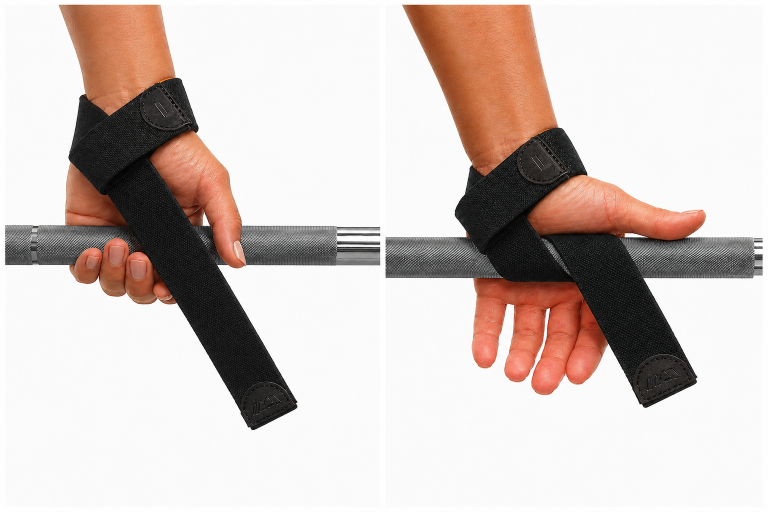
Lifting straps are typically made of strong fabric or leather and are looped around both your wrist and the barbell. By creating a secure physical connection, straps reduce the effort required from your grip, allowing you to focus on activating and fatiguing your larger back muscles.
What the actual research says about straps:
- Increased Repetitions with Preserved Grip Strength: Trahey et al. (2023) found that using lifting straps allowed women to perform more repetitions in the deadlift while preserving grip strength, without negatively affecting barbell velocity. The authors found that straps permit greater training volume without the velocity drop—a meaningful outcome, since a velocity drop would otherwise limit the quality of those additional repetitions.
- Greater Mechanical Performance and Lower Perceived Exertion: Jukic et al. (2021) demonstrated that lifting straps during deadlifts allow for better maintenance of grip strength, faster grip strength recovery following training, and greater perceived grip security and power, while also increasing mechanical performance and decreasing perceived exertion.
- Increased Total Work Performed: Coswig et al. (2015) found that using straps increased the total work performed during deadlift training, concluding that straps “directly influences exercise performance that requires manual grip strength.”
A note on sample sizes and scope: These studies are relatively small—Trahey et al. tested ten women, Jukic et al. tested sixteen men, and Coswig et al. tested eleven subjects—and Trahey’s is the only study conducted in a female cohort. The findings are consistent across these samples, but the evidence base remains limited in scope. Additionally, none of these studies directly measured muscle growth (hypertrophy). The hypertrophy benefit is a reasonable inference from the increased work capacity straps provide, not a directly demonstrated finding in these particular papers.
Reconciling the Research: Coswig and Jukic on Bar Velocity
The relationship between straps and barbell velocity is more nuanced than a simple “faster or slower” story. Here’s how the two studies fit together:
Jukic et al. (2021) found that when comparing straps vs. no straps at the same absolute load, deadlifts performed with straps produced greater mean and peak velocity than those performed without. This makes sense: when grip is no longer the limiting factor, you can exert force more explosively.
Coswig et al. (2015) found that when subjects performed a 1RM test both with and without straps, then did multiple sets to failure at 90% of their respective 1RM in each condition, the strap condition produced lower bar speed and greater total force duration. However, this is likely a methodological artifact. If the strap 1RM was higher (which is expected, given that straps allow more force production), then the 90% load in the strap condition was heavier than the 90% load without straps. Lifting a heavier bar at the same relative intensity would naturally produce lower velocity.
The clean reconciliation is this: At the same absolute load, straps make you faster. At load-matched relative intensities (where the strap condition uses heavier absolute weight), velocity may be lower—but that’s because you’re lifting more weight, not because straps degrade performance.
What Straps Don’t Do (and the Downsides)
While straps can enhance your training, they aren’t a cure-all. Here’s what they don’t change:
- Grip Strength Development: This is a matter of training specificity. If you always use straps, your forearms are not exposed to the heavy isometric loads required to drive adaptation. While no study is cited here to prove “atrophy,” the principle of specific adaptation to imposed demands (SAID) logically dictates that bypassing the grip will limit its strength gains relative to your back.
- Technique: Straps do not fix poor form. If your lumbar spine rounds excessively or you fail to brace, straps will not prevent injury. In fact, by allowing you to hold heavier weights, they demand more technical discipline, not less.
- Functional Carryover: Real-world tasks and many sports require strong grip. Overuse of straps can mean less carryover to those activities.
When to Use Lifting Straps
The best approach is a balanced one. Use straps strategically, not as a crutch. Here are practical guidelines:
- Heavy Working Sets: Save straps for your heaviest sets where grip is the undeniable limiting factor.
- High-Volume Back Work: Incorporate straps during high-rep rows or pulldowns where grip fatigue accumulates faster than back fatigue.
- Avoid for Warmups: Do your warmup sets and lighter accessory work without straps to keep challenging your grip.
- Dedicated Grip Training: Include exercises like farmer’s walks, static holds, or thick bar work to intentionally build grip strength.
Practical Example: Deadlifts
Imagine you’re deadlifting. You can pull 315 lbs for 8 reps, but by rep 6, your grip starts to slip, even though your back feels strong. Without straps, your set is cut short mechanically—the bar rolls out. With straps, you can complete all 8 reps with controlled form, giving your back the full stimulus. More total work performed by the target muscles is a primary driver of strength and hypertrophy adaptations (Schoenfeld, 2010). Over time, that increased work adds up to greater muscle growth and strength. But if you always use straps—even for light sets—your grip strength may lag behind.
Summary Table: What Straps Change vs. What They Don’t
| What Straps Change | What Straps Don’t Change |
|---|---|
| Increase the number of reps you can perform before grip failure (Trahey et al., 2023) | Don’t improve grip strength on their own |
| Allow better maintenance of grip strength and faster recovery (Jukic et al., 2021) | Don’t fix poor lifting technique |
| Increase mechanical performance and decrease perceived exertion (Jukic et al., 2021) | Don’t eliminate injury risk—poor form can still cause spinal or muscular injury |
| Increase the total work performed by target muscles (Coswig et al., 2015) | Don’t replace the need for dedicated grip work |
| At the same absolute load, increase bar velocity (Jukic et al., 2021) | Don’t build the forearm strength required to hold that load without them |
Key Takeaways
Lifting straps are a valuable tool backed by real performance data: they allow more reps, greater mechanical output, more total work by the target muscles, and lower perceived exertion. However, they are not a replacement for grip training or good form.
Use them judiciously—save them for your toughest working sets, avoid them on warmups, and never let them lull you into lifting with poor spinal mechanics. And if you choose the mixed grip as an alternative, be aware of the documented risk to your supinated arm’s biceps tendon: in a study of deadlift-related distal biceps ruptures, all occurred on the supinated side.
References
- Trahey, K. M., Lapp, E. M., Talipan, T. N., Guydan, T. J., Krupka, A. J., & Ellis, C. E. (2023). The effect of lifting straps on deadlift performance in females. Journal of Strength and Conditioning Research, 37(10), 1924–1928.
- Jukic, I., García-Ramos, A., Baláš, J., Malecek, J., Omcirk, D., & Tufano, J. J. (2021). Ergogenic effects of lifting straps on movement velocity, grip strength, perceived exertion and grip security during the deadlift exercise. Physiology & Behavior, 229, 113283.
- Coswig, V. S., Machado Freitas, D. F., Gentil, P., Fukuda, D. H., & Del Vecchio, F. B. (2015). Kinematics and kinetics of multiple sets using lifting straps during deadlift training. Journal of Strength and Conditioning Research, 29(12), 3399–3404.
- Kapicioglu, M., Bilgin, E., Guven, N., Pulatkan, A., & Bilsel, K. (2021). The role of deadlifts in distal biceps brachii tendon ruptures: An alternative mechanism described with YouTube videos. Orthopaedic Journal of Sports Medicine, 9(3), 2325967121991811.
- Schoenfeld, B. J. (2010). The mechanisms of muscle hypertrophy and their application to resistance training. Journal of Strength and Conditioning Research, 24(10), 2857–2872.