A Weight Lifting Belt Is a Surface to Brace Against
Walk into any commercial gym on a Tuesday evening and you will see the belt worn as armor. It is cinched on before the warm-up sets and left on through the cable rows. It sits high on some lifters and low on others. It is often loose. It is often decorative.
None of this is a moral failure. The belt has been marketed for decades as back support, and if a piece of equipment is sold as support, people will wear it whenever they think they need support. That is a rational response to the language used to describe the product.
But the belt does not work by supporting the back. It works by giving the lifter something to press against.
What the belt actually does
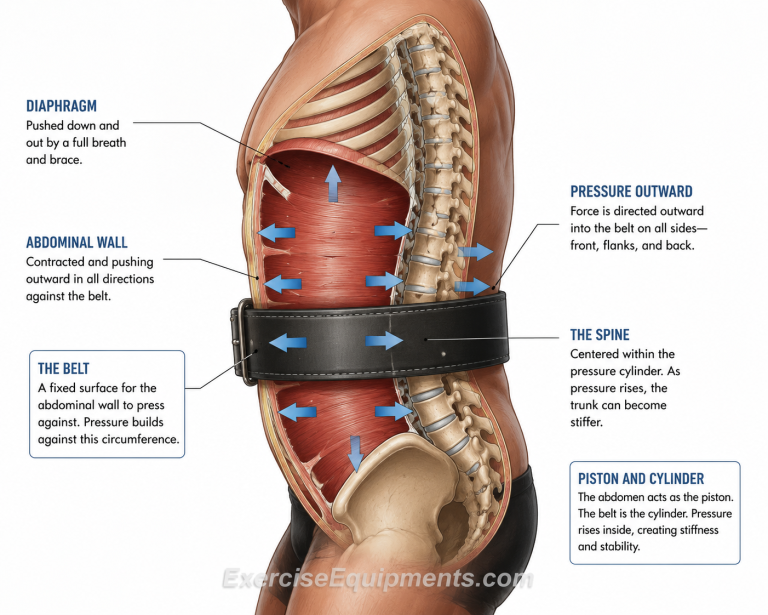
Under a heavy squat or deadlift, the trunk needs to become rigid. A soft trunk lets force leak out of the lift and can allow more spinal movement under load. The lifter produces rigidity by taking a large breath, holding it, and pressing the diaphragm down while contracting the deep abdominal wall outward. The fluid and gas contents of the abdomen have nowhere to go and pressure rises. This is intra-abdominal pressure. As pressure rises, the trunk can become stiffer.
The belt does not create this pressure. The lifter does. What the belt does is give the abdominal wall a fixed surface to push against. Instead of the muscles expanding freely into open space, they meet leather. The wall of the abdomen becomes a piston pressing against a cylinder — and against that fixed circumference, pressure can rise earlier and hold higher than it would in open air.
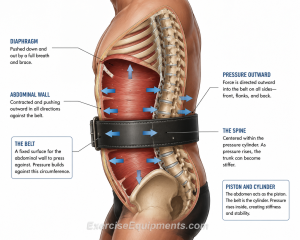
This was measured directly by Harman and colleagues at the U.S. Army Research Institute of Environmental Medicine, published in Medicine & Science in Sports and Exercise in 1989. Nine subjects deadlifted at ninety percent of their maximum, once with a belt and once without. Intra-abdominal pressure was recorded through a catheter transducer while ground reaction force was recorded through a force platform. Wearing the belt, subjects reached peak intra-abdominal pressure significantly earlier than they did without it, and peak intra-abdominal pressure itself was significantly greater with the belt on. The belt did not lift the weight. It changed both the timing and the magnitude of the pressure the lifter already generated.
A later study, published by Miyamoto and colleagues in Clinical Biomechanics in 1999, looked at what happens inside the muscles themselves. With the belt on, intramuscular pressure inside the erector spinae — the long muscles running along the spine — increased significantly during Valsalva maneuvers and heavy isometric lifting. Maximum lifting capacity and peak intra-abdominal pressure did not significantly differ in their measurements. The belt, in other words, did not make the lifter stronger in that test. It changed the mechanical environment around the spine while the effort was happening.
Both findings point in the same direction. The belt is a mechanical surface. The lifter is the pump.
Why this matters for the wearer
If the belt mainly amplifies a brace the lifter is already producing, then two people wearing identical belts can get very different results from them.
A lifter who takes a full breath into the belly, holds it, and pushes the abdominal wall outward against the leather will feel the belt come alive under their hands. The trunk stiffens. The lift feels shorter and more organized. The bar moves.
A lifter who slings the belt on tightly and then holds their breath in their chest — sucking the belly in, or leaving it slack — gets far less from it. The belt sits on them, but very little pushes against it. In this case the belt is still doing something mechanically, but the wearer is not asking much of it, and it has little to answer with.
This is why coaches who have watched thousands of lifters — the strength coaches interviewed in the Girls Gone Strong roundtable on belt use are one example — often suggest that new lifters spend time learning to brace without a belt before they start wearing one. The belt does not teach the brace. It rewards the brace that already exists.
When the belt earns its place
Given the mechanism, the practical question is not “how heavy do I have to lift before I wear a belt.” It is closer to “am I already bracing hard enough that a belt would add something to press against.”
For most trained lifters, that condition is met somewhere in the top working sets of the main compound lifts — heavy squats, deadlifts, standing overhead presses, cleans, and their close relatives. These are the lifts where the trunk is loaded axially and where losing rigidity can affect force transfer and spinal positioning. This is also where the peer-reviewed measurements were taken. Extending belt use to lighter warm-ups, isolation work, machine exercises, and accessory movements is more a matter of preference than mechanics; the brace built during those lifts tends to matter less to the outcome, so the belt has less to amplify.
There is a related and older concern — that habitual belt use will weaken the trunk musculature over time. The available evidence does not support this. Studies that have measured trunk muscle activation with belts on tend to find equal or increased activation of the abdominal wall, not less, alongside a reduction in erector spinae activity at a given load. It is also common to see elite strength athletes use belts for their heaviest work. The belt does not do the lifter’s job. It rewards the lifter for doing it.
The kind of belt matters less than most pages suggest
Most of the top-ranking pages spend considerable space on materials and closures — leather versus nylon, prong versus lever versus quick-lock, 10mm versus 13mm. These distinctions are real but secondary. What matters mechanically is that the belt is stiff enough that the abdominal wall can push against it without the belt itself deforming, and that it is wide enough at the front — not only at the back — to receive that push.
A traditional powerlifting belt is uniform in width all the way around, usually four inches, sometimes wider. That uniformity is not aesthetic. A belt that tapers to a narrow strap in front — the shape of many older bodybuilding belts — offers less surface for the abdomen to press against. It may still feel supportive; it will not amplify the brace in the same way.
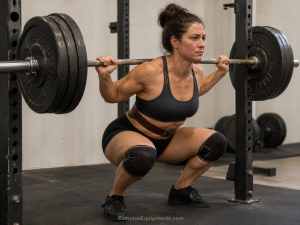
Thickness — 10mm, 13mm — changes stiffness. Beyond a certain point, a stiffer belt is not more supportive; it is harder to breathe into. A belt the lifter cannot fully expand against is a belt that is doing less than it looks like it is doing. Beginners are generally better served by a slightly thinner, slightly softer belt they can actually brace against than by the stiffest belt on the market.
Closure — lever, prong, quick-lock — is mostly a matter of convenience and how often the same tightness is wanted from set to set. It does not change the mechanics much either way.
How to use it
Most guidance places the belt above the hips, covering the area between the top of the pelvis and the bottom of the ribs — but the right height depends on torso length, the lift, and where the lifter actually feels the brace land. The starting rule is a rough guide, not a fixed line. The belt should be tight enough that the abdominal wall can push against it firmly on a full breath, and loose enough that a full breath is possible at all. If it has to be loosened between sets to breathe normally, it is too tight; if a flat hand slides under it while braced, it is too loose.
Before the lift, the sequence is: breathe deeply into the belly, expand outward against the belt on all sides — front, sides, and lower back — hold that pressure, and lift. The breath is held until the hard part of the lift is done.
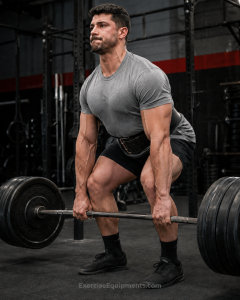
None of this requires the most expensive belt in the store. It requires the belt to fit, and it requires the lifter to know what to do with it.
The quiet point
The weight lifting belt is one of the few pieces of gym equipment whose usefulness depends almost entirely on the skill of the person wearing it. A pair of shoes with a raised heel raises the heel regardless. A knee sleeve warms the joint regardless. The belt waits. It is a fixed circumference of leather or nylon, and nothing happens inside it until something presses out.
That is the whole of it, at the top of the heaviest set of the day: a breath held, a belly pushed hard into a wall of leather, a spine made briefly rigid by the meeting of the two.Weight Lifting Belt: What It Actually Does, and When to Wear One