Tai Chi Sword: The Form That Tells the Truth
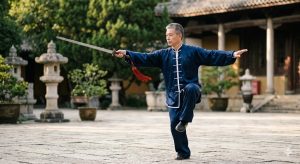 Tai Chi Sword: The Form That Tells the Truth
The empty hand will lie to you. The tai chi sword will not. Tension hides easily inside a relaxed-looking arm, and a knee that never settled hides easily inside a soft-looking step. Put a thirty-six-inch jian into your hand, with weight at the tip, and the shortcuts you have built into your form start announcing themselves.
The blade is not the point of the work, but the thing that lets you see what you have been doing.
What a Tai Chi Sword Actually Is
The weapon used in this practice is the jian, a straight, double-edged Chinese sword with a tapered tip and a balance point a few inches above the guard. A traditional tai chi sword runs between 28 and 32 inches in blade length and weighs roughly one to one-and-a-half pounds. Practice versions come in wood, aluminum, flexible stainless steel, or live-edge carbon steel for advanced practitioners. The basic shape has not changed since the Qing dynasty, which means the variable has always been the practitioner rather than the tool.
The jian is sometimes called the gentleman’s weapon because it rewards precision over force. A practitioner who tries to hack with it produces a clumsy chop the blade is not built for, and a thrust executed without alignment causes the point to wobble in a way grip cannot correct.
Why the Tai Chi Sword Tells the Truth
Empty-hand tai chi rewards patience, and it forgives a great deal. A practitioner can spend years cycling through the form with subtle errors. A hip that floats. A shoulder that rises during transitions. A weight transfer that completes a beat late. The body compensates well enough that nothing looks wrong, and the form keeps moving along with the errors tucked quietly inside it.
The tai chi sword ends that arrangement. The blade extends the practitioner’s center by another three feet, and every error at the trunk amplifies at the tip. A shoulder that rises a half-inch becomes a sword tip that drifts six inches off target. A weight transfer that arrives late becomes a thrust without root behind it. The same body that looked acceptable empty-handed is now visibly compensating at the end of a long visible lever.
Old teachers used to say the sword should feel like an extension of the arm. That is true and slightly misleading. The sword feels like an extension of everything: the feet, the breath, the gaze, the intent behind the gaze. It connects all of them, or reveals where the connection isn’t.
What the Blade Reveals
Alignment. A jian held at full extension shows whether the spine, the shoulder, and the arm are in line with each other. They almost never are in the beginning, and the tip keeps trembling until the practitioner stops adjusting the arm and starts adjusting the body it is attached to.
Weight transfer. When the sword leads, the body has to follow with timing rather than effort. A heavy weapon at the end of an unrooted stance feels exactly as unstable as it is, and most practitioners discover that the relationship with the floor they thought they had built was looser than it looked.
Hand connection. The non-sword hand, called the sword fingers or jian zhi, is not decoration. It counterbalances the blade and tells you whether the two sides of your body are still talking to each other. Most beginners discover they have one engaged hand and one decorative one, and that the decorative one has been disconnected from the work for a long time.
Gaze and intent. Where the eyes go, the sword goes. A wandering gaze produces a wandering point, and the tai chi sword requires the practitioner to direct attention through the blade to a specific target, real or imagined. The form does not tolerate the soft focus that empty-hand practice can drift into, where the eyes settle on nothing.
Breath. The sword exposes whether the breath is moving at all. Most practitioners do not notice they are holding their breath during transitions until the blade tells them: a held inhale produces a tight wrist, and a tight wrist produces a wobbling tip. The feedback arrives in seconds.
How to Start With the Tai Chi Sword
Most students begin with the 32-movement simplified form. This sequence was standardized by the Chinese State Sports Commission in 1957 to make the practice teachable at scale, and it remains the most widely practiced tai chi sword sequence in the world. The International Wushu Federation includes the 32-movement taijijian in its elementary competition routines, codifying it as the international entry point to the discipline (IWUF Wushu Taolu Competition Rules, 2024).
Choose a practice sword you can actually move. A blade that is too heavy will train compensation, and a blade that is too light will not teach you anything. For most adults, a one-pound aluminum or wood jian in the 28-to-30-inch range is the right starting weight. Save the live-edge carbon steel blade for the moment your teacher tells you that you are ready.
Then expect the first six months to humble you. The empty-hand form you polished for years will suddenly feel new, and postures you thought you owned will reveal a hip that floats or a shoulder that grips. None of that is failure. That is the tai chi sword doing what the practice was built to do.
What to Do With What the Sword Shows You
The diagnostic is only useful if the practitioner does something with it. Most do not. The common response is to keep cycling through the form at the same speed and treat the wobbles and tip drift as cosmetic problems that will smooth themselves out with repetition. They will not. A subtler version of the same mistake is to fight the feedback, tightening the grip and bracing the shoulder until the tip behaves. The form gets stiffer, the error hides under a new layer of tension, and the practitioner has learned a compensation instead of a correction.
The useful response is slower and less satisfying. Stop. Find the posture where the tip drifted. Set the sword down. Locate the same error in the empty-hand version, where it lives, and work it there until the structure changes. Then pick the blade back up. The sword becomes the question, and the empty-hand form becomes where the answer is built.
The Sword Is Not a Decoration
There is a temptation in modern practice to treat the tai chi sword form as performance, something elegant to demonstrate after the hand form is supposedly “finished.” This misunderstands what the weapon is for. The sword is not a graduation prize, but closer to a mirror that took a few years to manufacture and that you finally get to look into.
Pick it up and the form you have been carrying for years suddenly speaks. Some of what it says will be flattering, most of it will not be, and the right response in either case is to keep practicing. The blade is the most patient teacher in the room, willing to repeat the same correction for as long as the practitioner is willing to listen.
Frequently Asked Questions
What is a tai chi sword used for?
A tai chi sword is a training instrument that extends the principles of empty-hand tai chi into a weapon form. It develops alignment, balance, precision of intent, and the connection between the two sides of the body. Historically the jian was a battlefield and dueling weapon, but in modern practice the tai chi sword functions as a diagnostic that makes visible what the empty-hand form can quietly hide.
How heavy should a tai chi sword be?
A starting tai chi sword should weigh between one and one-and-a-half pounds for most adults. Lighter blades fail to load the structure enough to teach root and alignment. Heavier blades cause practitioners to muscle the form and bury the errors they came to find. The weight should be enough that you feel the tip during transitions, but not so much that your shoulder starts compensating.
Which tai chi sword form should I learn first?
Most teachers start beginners with the 32-movement simplified form, a sequence that takes three to four minutes to perform. After that, the 55-movement Yang style form or the 42-movement competition form extends the vocabulary. The traditional sequences in each style, including Yang, Chen, Wu, and Sun, run longer and assume the simplified form has been internalized first.
Do I need to learn empty-hand tai chi before the sword?
Yes. The sword form assumes the practitioner already understands what the empty-hand form teaches: rooting, weight transfer, central equilibrium, and opening and closing. Picking up a tai chi sword without that foundation produces choreography rather than practice. Most schools require at least one full empty-hand form before introducing the jian.
Is a tai chi sword sharp?
It depends on the sword. Training jians made of wood, aluminum, or flexible spring steel are dull by design. Traditional carbon-steel jians for advanced practitioners are sharpened along the final third of the blade and at the tip, enough to function as a real weapon without posing casual danger to the user. A live-edge tai chi sword is not a beginner’s tool, and most practitioners never need one.