Most people searching for recurve bow strings start by comparing materials — Dacron versus Fast Flight, B50 versus D97, Flemish twist versus endless loop. That is the wrong starting point. Before any of those decisions matter, your bow has to answer one question: is it built to handle a low-stretch string? The answer to that question determines everything. Get it wrong on the wrong bow and you risk shearing a limb tip off at full draw. That is not a hypothetical — it is a documented failure mode that happens when archers fit modern high-performance strings to bows that were not built for them.
Start with the bow. Everything else follows.
Why Recurve Bow Strings Are Not Interchangeable
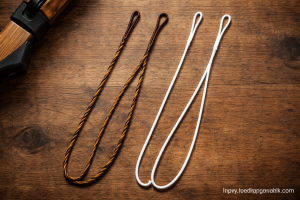 The critical difference between modern string materials is how much they stretch. Dacron — sold as B50 by Brownell and B55 by BCY — stretches approximately 2.6 percent under load. That stretch acts as a buffer, absorbing some of the shock that travels back through the string when the bow hits brace height after a shot. On a wooden bow or an older recurve with unreinforced limb tips, that buffering is not optional. It is what keeps the limb tips intact.
Fast Flight materials — Dyneema, D97, 8125 and similar — stretch very little. They transfer more energy into the arrow, which produces faster arrow speeds. But they also transfer more shock into the bow at the moment of release. Modern recurves are designed and built with reinforced limb tip overlays specifically to handle this. Older bows and wooden self bows are not. Fitting a Fast Flight string to a bow that was not built for it is a reliable way to damage or destroy the limb tips.
The rule is simple: if your bow’s manufacturer specifies Dacron, use Dacron. If the bow is marked as Fast Flight compatible — or if it is a modern fiberglass or carbon limb recurve with reinforced tips — you have the option of using either. When in doubt, B50 Dacron is always the safer choice and still produces entirely adequate performance for most archers.
String Length: How to Get It Right
Recurve bow strings are sold in AMO lengths — a standard set by the Archery Manufacturers Organisation that refers to the length of the bow, not the actual string. For a recurve bow, the correct string length is four inches shorter than the AMO bow length. A 62-inch recurve bow takes a 58-inch string.
This distinction matters because some retailers list actual string length rather than AMO length, which creates confusion when ordering replacements. Always check which measurement is being used before you buy. The AMO bow length is typically stamped or labelled on the riser or limbs. If it is not, measure along the curve of the limbs from string groove to string groove — that is your AMO length, and your string should be four inches shorter.
Getting the string length wrong affects brace height — the distance from the string to the grip at rest. Too short a string raises the brace height and increases draw weight; too long reduces it and makes the bow sluggish. Neither is what you want, and neither is correctable without replacing the string.
Strand Count: Match It to Your Draw Weight
String strand count affects strength, durability, and the weight of the string itself. For Dacron B50 strings — the most common material for recreational and beginner recurves — the standard recommendations are straightforward: 12 strands for bows up to 35 pounds, 14 strands for bows between 35 and 50 pounds, and 16 strands for bows above 50 pounds. Using too few strands on a heavier bow puts each strand under greater stress and accelerates wear. Using more strands than necessary adds weight to the string without meaningful benefit.
For Fast Flight compatible bows using modern materials, strand counts are generally lower — 10 to 12 strands is typical — because the individual fibres are stronger and require fewer of them to achieve the same load capacity.
Flemish Twist vs Endless Loop
These are the two construction styles for recurve bow strings and the choice between them is largely personal, though each has practical characteristics worth knowing.
A Flemish twist string is hand-braided with twisted strands and loops that are part of the string’s structure. It has a traditional appearance, is relatively easy to replace in the field without tools, and is forgiving — the loops can be adjusted by twisting to affect brace height. Most traditional archers and barebow shooters favour Flemish strings for the feel and the connection to the bow’s heritage.
An endless loop string is machine-made with loops formed separately and served onto the string. It tends to be more consistent from string to string, holds its brace height more reliably once broken in, and is the standard choice for Olympic recurve archers shooting at high volume. It is typically available in a wider range of modern materials and strand configurations.
For most recreational recurve archers, particularly those shooting traditional or barebow, a Flemish Dacron string is the natural starting point. For competitive archers working with ILF equipment and modern limbs, an endless loop in a low-stretch material is the more common choice.
When to Replace Your Recurve Bow String
A recurve bow string does not fail dramatically in most cases — it frays gradually, and that gradual wear is what makes inspection important. Check the string at every session, paying particular attention to the loops where they seat in the limb tip grooves. This is where friction and abrasion are greatest, and where early fraying most commonly appears. If individual strands are broken or the serving is separating, replace the string before the next session.
As a general guideline, a well-maintained Dacron string on a regularly shot recurve should be replaced every one to two years. Fast Flight strings are more durable and typically last longer, but they still require regular waxing — applied along the length of the string and worked in with your fingers — to prevent the fibres from separating and to extend service life.
Never leave a recurve bow strung when it is not in use. The sustained tension accelerates string fatigue and stresses the limbs unnecessarily. Unstring after every session and store the bow and string separately.
The One Thing Worth Remembering
The string is not a universal component. It is matched to a specific bow, and the bow’s design determines which materials are safe. Before you order recurve bow strings, confirm whether your bow is Fast Flight compatible, measure or look up the AMO length, and match the strand count to your draw weight. Everything else — brand preferences, construction styles, material nuances — comes after those three things are established.
For a detailed breakdown of how different string materials perform and how to select them for specific bow types, Lancaster Archery’s recurve string guide is one of the most practical and honest resources available.