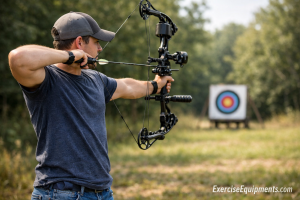
 Most people shopping for a compound bow for beginners start by looking at bows. That is the wrong order. Before you compare brands, read reviews, or step into a pro shop, there are two numbers specific to your body that determine whether any bow will work for you — and if you get them wrong, no amount of money corrects the mistake. This article gives you those numbers first, because everything else depends on them.
The Mistake That Ends More Archery Careers Than Anything Else
It is called being “overbowed.” It means buying a bow with more draw weight than your body can handle properly — and it is the single most common reason beginners quit. The symptoms are easy to miss at first: your form starts to break down before you even notice, your shoulder strains a little more each session, and the arrows start going everywhere except where you aimed. You blame your technique. You put the bow down for a week. Then longer.
What actually happened is that you bought a bow sized for a stronger or more experienced archer, drew it back under pressure from a salesman or an internet forum, said it felt fine, and started practising a compensated form that will take months to unlearn — if you stick around long enough to unlearn it.
Every experienced archer says the same thing: start lighter than you think you need to. A man in good physical condition who wants to hunt deer does not need 70 pounds. Fifty to sixty pounds is the practical ceiling for most hunters. For a compound bow for beginners focused on building form, 40 to 50 is better. You can always turn a bow up. You cannot undo the habits six months of overbowing builds into your body.
Your Draw Length: The Number That Fits You to a Bow
Draw length is the distance from the bowstring at full draw to the grip — essentially how far your body naturally pulls a bow back. Every compound bow is built around a specific draw length range, and shooting outside that range is the second fastest way to ruin your form and your experience.
You can estimate your draw length at home with a tape measure and another person. Stand with your arms outstretched parallel to the floor, palms forward. Have someone measure fingertip to fingertip across your full wingspan. Divide that number by 2.5. The result is your approximate draw length in inches.
For example: a 70-inch wingspan divided by 2.5 gives a draw length of 28 inches — the most common adult draw length and the standard against which most bow specs are written. If your number comes out at 25 or 31, that matters enormously for which bow to buy. A bow fixed at 28 inches is not the right bow for you.
Look for a compound bow for beginners with an adjustable draw length range that comfortably spans your measurement with room on both sides. Most modern beginner bows adjust 5 to 10 inches. This is a feature worth prioritising over brand name or arrow speed rating.
What the Spec Sheet Actually Means
Walk into a shop and you will see something like: 60 lb / 25–30″ / ATA 32″ / 85% let-off / 310 FPS IBO. Here is what each number means for someone buying their first bow.
Draw weight (60 lb): The peak force in pounds needed to pull the string to full draw. Start in the 40–55 lb range and build up. Going heavier immediately is how form breaks down.
Draw length (25–30″): The range the bow adjusts to. Your measured draw length should sit comfortably in the middle of this range, not at the edge.
ATA — axle to axle (32″): The length of the bow from one cam axle to the other. Shorter bows are more maneuverable in a tree stand or tight cover. Longer bows are more forgiving for target shooting. For hunting, 28–33 inches is practical.
Let-off (85%): The percentage of draw weight that releases at full draw through the cam system. At 85% let-off on a 60-pound bow, you are holding only 9 pounds at full draw. This is the mechanical advantage that makes a compound manageable to aim — and why a heavier draw weight is more tolerable on a compound than a recurve.
IBO speed (310 FPS): Arrow speed under standardised test conditions. For a beginner hunting deer at under 40 yards, this number does not matter. Shot placement matters. Do not pay a premium for speed you will not use.
What to Actually Buy as a Compound Bow for Beginners
With your draw length and a target draw weight in hand, the field narrows quickly. Look for a package bow — sold with a sight, arrow rest, stabiliser, and quiver included. This removes the decision fatigue of selecting individual components and keeps the initial cost contained. Most reputable package bows in the $300–$500 range include serviceable accessories that will last through a learning period.
Brands worth considering include Bear Archery, Diamond Archery (a sub-brand of Bowtech), and Genesis. All three build reliable adjustable bows with wide draw weight and length ranges, and their package accessories are honest rather than decorative. Avoid unbranded bows on e-commerce platforms under $150 — setup inconsistencies alone will cause accuracy problems that no amount of practice can correct.
Buying from a local pro shop, even at slightly higher cost, is worth it for a first bow. They will measure your draw length accurately, set the bow to your specs, paper tune it, and give you somewhere to go when questions arise. Buying a compound bow for beginners cold from a box store, untuned and unmeasured, is one of the most reliable ways to have a frustrating first season. Lancaster Archery’s beginner bow guide walks through the full fitting and setup process and is one of the most trustworthy free resources available.
The Budget Reality Nobody Mentions
The bow is not the only expense. Budget an additional $100–$200 for arrows, a release aid, and a target. Arrows must be matched to your draw length and draw weight — buying the wrong spine affects accuracy as much as a poorly fitted bow. Ask your pro shop to recommend arrows matched to your specific setup at the same time they set up the bow.
The total realistic entry cost for a beginner ready to hunt or shoot seriously is $500–$700 all-in. Spend more time on draw length and weight fit than on brand comparisons. A correctly fitted $350 bow will outperform a mismatched $700 bow every time.
One Last Thing Before You Buy
Shoot before you spend. Any pro shop worth visiting has a lane. Any bow worth buying can be demoed. The feel of a bow at full draw — the back wall, the valley, the way the let-off settles — is not something a spec sheet communicates. For a compound bow for beginners, comfort and fit matter more than speed, brand loyalty, or what a forum recommends. You are the variable the numbers cannot account for. Go draw the bow before you buy it.